Tuesday, September 29, 2009

MEDJUGORJE: DIVINE INTERVENTION OR DIABOLICAL DECEPTION?


"[Evil spirits] have at times recommended that which is good in order to hinder a greater good, and have encouraged persons to do a particular act of virtue that they may the more easily deceive the unwary..." Pope Benedict XIV, Servorum Dei beatifactione et Beatorum canonizatione.

I used to believe in Medjugorje; I believed it with my whole heart. As an agnostic turned Catholic, who turned to Catholicism after being touched by Our Lady of Lourdes, France, I was ripe to believe that Medjugorje was another divine intervention in the modern world. Moreover, I believed that those who did not believe in Medjugorje had hardened their hearts, in a sense, against God.

So what is “Medjugorje” to those who do not know what this phenomenon is? Medjugorje is a town in the former Yugoslavia where six mostly teenage “visionaries” are reputed to have begun seeing Our Lady, a receiving messages from her, beginning
in the summer of 1981, while frequenting their favorite smoking hide-out.

Millions of souls flock to Medjugorje; good souls, holy Catholic souls, searching for greater meaning; searching for a touch of grace—a ray of meaning in this difficult life. The souls who go there are almost without exception good Catholics: They pray there, they go to confession, they attend daily mass, and many of them return home extolling the “fruits” of Medjugorje.

We hear of a millionaire stockbroker who became a priest; drug addicts who renounce their habits; those who have been away from the Church for decades returning to the fold. James Caviezel, who played Jesus in The Passion, is a friend of one of the “visionaries.”

Despite such inflated hyperbole, one cannot deny that many fruits from Medjugorje have been good: A woman, Rita Klaus, was apparently healed of multiple sclerosis after reading about Medjugorje; the divorced and remarried Protestant journalist Wayne Weible was so overcome by Medjugorje that he wrote several books on the subject and converted to Catholicism. Most interestingly, a former editor at Rolling Stone magazine, Randall Sullivan, experienced such “phenomena” at Medjugorje that he wrote a book largely devoted to the phenomena, The Miracle Detective, had his kids baptized Catholic, but still—to my knowledge—has not converted to the Faith himself.

However, my wife, myself, and, just recently, my eighty-four year old grandmother converted to Catholicism without ever having heard of Medjugorje, and so I doubt it is, or ever has been, the great converter of the unconverted that some claim it to be. The Catholic missionaries used the Traditional Latin Mass and steely resolve to convert millions to the faith. Still, there are, seemingly, good fruits coming out of Medjugorje. Early scientific and psychological testing of the “visionaries” did not show signs of duplicity. It’s likely that the visionaries believe in what they see; I don’t think they conspired with each other to make a buck. The visionaries are basically good, and honest people trapped in a, possibly, diabolical deception. The devil parades as an angle of light. 95% of what is said and happening at Medjugorje seems good, it is the 5% of strange unorthodoxy that is troublesome. The air of legitimacy and good fruits coupled with messages out of whack with the deposit of faith is what makes Medjugorje phenomena to be treated with caution. On the one hand, we Catholics love Our Lady, but we should be cautious in the milieu of today’s Marian apparitions for just that reason: We need to love Our Lady for who she really is, and not a deception. One need only look to Bayside, New York, where a delusional woman claimed to see Our Lady, to see how strange Marian “apparitions” can become. Bayside had a huge cult following; it had reputed miracles to support it, including silver rosaries turning gold, miraculous healings and seemingly unlimited financial resources—these things also happen at Medjugorje. Bayside was declared invalid by the local Bishop, as has Medjugorje by every local Bishop since the phenomena started.

But I am not the ultimate arbiter on Medjugorje, the Church is. I accept her judgment either way. Perhaps the strange behavior of some of the seers at Medjugorje are similar to the way one of the seers acted in later life at the nineteenth-century Church-approved apparition site of La Salette, in France. It is possible to distinguish an apparition from its visionary. However, one can look at the two most recent examples of Church-approved apparitions, and see a great contrast with Medjugorje: At Lourdes, France, the one visionary, Bernadette Soubirous, became a nun. Similarly, the one surviving visionary from Fatima, Portugal, became a nun. On the other hand, the seers at Medjugorje have become hotel owners, jet setters, and live on the newly created “millionaires-row” in the once extremely humble hamlet of Medjugorje. One of them, Vicka, has even claimed that Mary wanted a hotel built in 1995 (Mary the contractor)! Some of the seers split their time between Medjugorje and other locations. One seer married “Ms. Massachusetts,” has driven a Mercedes and BMW, and splits his time between Medjugorje and Boston, where two years ago he sold his condo for $640,000 because. He is also known to take a smoking break during mass.

Not to say wealth is bad, per se: King Saint Louis IX was “wealthy” (though swore it off, and wore sack cloth before he died on Crusade). The great Saint Therese of Liseux had parents of means, but St. Therese swore-off wealth and died a poor nun. Jesus was born in a manger, and his earthly father was a carpenter, and his other an extremely humble servant of God. Therefore, one can assume, God does not favor the rich. If this is true, why would God, though Mary, set-up a situation where a group of seers, claiming Mary as their Visionary, would become wealthy hotel-owners?

But still, you might ask, why would I wish to disparage phenomena that is near and dear to the hearts of so many? Why would I write negatively of phenomena inspiring to millions of Catholics—phenomena which has produced good “fruits?” One need only look at the phenomena of Neale Donald Walsch’s “Conversations with God,” a heretical series of books followed by millions throughout the world, to see how easily millions of souls can be led astray by those claiming contact with the divine. Medjugorje has captured the hearts and minds of millions of Catholics throughout the world; Priests, Bishops, a few Cardinals, and even, possibly, Pope John Paul II believed in it. If it is false, it has the power of altering the Church away from her Divine mission.

The Church was built on the blood and bones of the martyrs. When Vicka says that Our Lady is not calling people to become Catholics, but that, “[T]he Blessed Mother says all religions are dear to her and her Son.” (“The Visions of the Children,” Janice T. Connell, St. Martin’s Press, 1992, pg. 119.) One is left with a feeling of indifferentism towards the Catholic faith. The martyrs' blood: Those who sacrificed all to teach the True Faith, and "convert all nations" becomes irrelevant. For the same reason, some of the greatest Saints' teachings become irrelevant. Also, the Bible becomes irrelevant because we are exhorted to spread the True Faith in it; but if God doesn't desire others to become Catholic, why bother? Catholicism, at least as understood in the non-modernistic sense, is not a "faith,” per se, but Truth itself. Medjugorje is diminishing that age-old understanding of our Faith. Dicey business, because the fruits, otherwise, seem good; I do believe people experience "signs and wonders" there, and there have been “conversions.”

In March 2007, I traveled to Paris with the express wish of visiting Our Lady of Chartres Cathedral; a ninety-minute train rides from Paris. Since it was still cold, I had the opportunity to experience Chartres away from the crowds, and in the off-season. This Cathedral holds mysteries that the average person cannot fathom. Christians worshipped at the very site where Chartres was built for a millennium and a half (one can still descend into the crypts and visit part of the church destroyed by the Normans in the ninth century.) In that span, the vapors of time have erased much of the history of that place, since the modern concept of written history is not available to us with respect to most of the history of Chartres, and we can only rely on oral history, conjecture, and the walls of the Cathedral itself to guide us.

Suffice it to say that Christians lived, died, and worshipped at Chartres for over a thousand years; long before it was turned into a “temple of enlightenment” during the Revolution in the eighteenth century, when local secularists even contemplated tearing it down! One can descend into the crypts of Chartres and pray where the earliest Christians prayed, over fifteen hundred years ago.

So how does Chartres tie-in to Medjugorje? Notre Dame de Chartres was dedicated to Our Lady, and held the shawl she wore when she gave birth to the Redeemer. In the crypts of Chartres I imagined Our Lady as the humble, selfless woman born without sin to St. Ann. Humbly giving birth to Our Lord in a stable, and raising Him as a child. I imagined the Catholics at Chartres praying to this humble Virgin century upon century. Chartres is a place of spiritual depth and meaning.

Medjugorje, on the other hand, has become the Disneyland of “mystical” phenomena. There is even an etymological term known as the “Medjugorje phenomena,” where there are those who stare at the sun for so long, expecting a miracle, that they damage their retinas.

On October 1, 1981 the seers asked Our Lady: "Are all religions the same?" to which the “Gospa” replied, "Members of all faiths are equal before God. God rules over each faith just like a sovereign over his kingdom. In the world, all religions are not the same because all people have not complied with the commandments of God. They reject and disparage them."
Interestingly, this quote cannot be found on the semi-official website for Medjugorje. Clearly, this quote is heretical. God cannot “rule over each faith like a sovereign over his kingdom,” for to do so would mean God gives credence and meaning to each faith, just like a sovereign does to his kingdom. Christ is King of just one Faith: The Roman Catholic Church. There are not multiple expressions of Truth, but a single Truth, contained in Christ, and expressed fully in the Holy Sacrifice of the Mass and the Deposit of Faith. The idea that Christ reigns over, say, the Moonies is absurd.

The “Gospa” has left tens of thousands of messages in Medjugorje, or, by extension, with the visionaries throughout the world, who seem to be able to conjure her wherever they may be, whether in the United States, Italy, or anyplace else. The famous “Mariologist,” Fr. Rene Laurentin, named one of the top 100 Catholic by “dailycatholic.org”—slightly behind Wayne Weible—is a major proponent of Medjugorje. Fr. Laurentin claims that Medjugorje is verified, in part, by the veracity of its visionaries. But are the visionaries really trustworthy? It is known that the “apparitions” started when the then teenage visionaries were smoking near a site where Croat Nazis slaughtered nearly a thousand people during World War II. The visionaries have been known to lie, or at least speak inconsistently, again and again. But the most troubling aspect with Medjugorje is the sense of syncretism inspired by it. It’s almost as if Medjugorje is inspiring a new faith within the Faith by very subtle means.

Fr. Rene Laurentin is also a huge proponent of a seer named Vassula Ryden, a Pan-Orthodox divorcee who claims that Jesus personally guides her hand in writing messages (http://www.tlig.org/en/background/handwriting/laurentin/). Ryden frequently speaks before the United Nations, where she espouses a syncrenistic understanding between protestants, Catholics and Orthodox. Fr. Laurentin cannot be relied upon as an authority on the veracity of Medjugorje since he has advanced a highly unorthodox seer. See, (http://www.ewtn.com/library/CURIA/CDFRYDN1.HTM.)

Vassula Ryden and Medjugorje both espouse a syncrenistic and indifferent understanding of the Church. This is opposed to the tradition of our Church. It is opposed to the great Saints and Martyrs who gave their live to advance the truth that Christ died to forgive us our sins, and created one Church to advance His mission on earth, and in that Church created the unbloodly Sacrifice of the Mass, as a mode whereby He would remain with us until the end of time.

E. Michael Jones wrote a book called "The Medjugorje Deception," Fidelity Press, 1998--it is a counterbalance to the superabundance of pro-Medjugorje books circulating and making millions out there (Michael Davies also wrote a book countering the Medjugorje phenomena.) As an aside, Jones was physically threatened by devotees of Medjugorje, do they not know that Christ's revelation ended around 2,000 years ago? One can believe or disbelieve in church-approved apparitions as one pleases (no less non-church approved ones, such as Medjugorje), and still be a good Catholic.

Generally well researched, here are a few nuggets from Jones' book: Bishop Peric, who was Bishop of Medjugorje at the time, was actually man-handled--his pectoral cross ripped off--by devotees of the "Gospa" of Medjugorje, who whisked him away to a chapel run by the Franciscans, and he actually had to be rescued by the Mayor of Mostar with U.N. troops in tow! [pg. xvii, from the introduction] Jones provides a nice quote regarding those who are constantly seeking a "high"-- a fix-- from ever-changing "mystical" phenomena, especially those in the charismatic movement, who the devotees of Medjugorje seem to be in abundance: "Either one grows into a mature faith--i.e. one not based on signs and wonders--or one looks for signs and wonders in ever-increadsing doess in order to maintain the spiritual high one remembers from the past." [pg. 37]

Quoting Father Jean Galot, Jones rightly points out that, "The frequency of an apparition, for example, is an argument against its authenticity because, '...it would arouse the image of a Christian religion that was nourished much more by actual visions than by the revelation brought in the past by the coming of Christ on earth. Piety would develop more as a function of constant apparitions than by the leap of faith...'" [pg. 66] Indeed! Although certainly Our Lady's coming to Fatima was necessarily predicated on our modern times, and scientific materialism.

Here is a passage that has long troubled me about Medjugorje, "The visionaries made virtually no show of devotion to the Eucharist and spent their time during mass talking and walking around [based on the impressions of Bishop Zanic]" [pg. 92] Whereas Fatima began and ended with the Eucharist, and the approved apparition of Akita was Eucharistically-based (and even Garabandal, which I'm not giving my opinion to one way or the other, was Eucharistically based) all Medjugorje could muster-up was a message by the Gospa that the children should prepare for the Eucharist for an hour "at least," before mass. [Messages, 1985] And then there are reports of Ivan, even in recent years, taking smoke breaks during mass; one is left with the impression of, "why would God create such a circus of irreverence towards his only Son?" Granted, the Gospa is given plenty of piety, but Mary herself would agree that her central role is to lead to Christ-God. Medjugorje seems to leave Christ in the periphery, all too often me thinks.

In the "visionary" Vicka's diary [9/4/1981] is a story about a bloody "handkerchief" soaked in blood, given to a "conductor." He was told to throw it into a river (by an unknown persona). He held-off, and met a woman, who turned out to be the Gopa. She asked for a handkerchief, and when he offered his own instead, she asked for the bloody one! He gave it to her, and she stated that if he had thrown the bloody one into a river, as instructed, the world would have ended. "The Gospa confirmed that this was the truth." [pg. 94]

Priests at Medjugorje also have a penchant for getting nuns pregnant. The recent story of Fr. Vlasic getting a nun pregnant and getting erstwhile with the Vatican is only one such story (although the biggest, since he was THE "spiritual advisor" to the "visionaries" and the major early proponent of their messages for some time), there is also the story of Fr. Ivica Vego, who also got a nun pregnant! This is a priest which the Gospa defended in his battle with the local Bishop previously. [pg. 147]

Then there is the fact that the Gospa can be transported from place to place to have messages broadcast, particularly if the person sponsoring the particular message-conduit-visionary has money! In one instance, the Gospa was amenable to having her apparition in a field in America at the base of a large tree, when thousands of pilgrims were too many to have it in a home. [pg. 153]

A Priest associated with Medjugorje for over ten years, who was a firm supporter, went to being a confirmed skeptic when he began to think that, indeed, the children were seeing a spiritual entity, but not the Virgin Mary. [pg. 352]

My eighty-four year old grand mother lives with the “Little Sisters” in Gallup, New Mexico. She became a Catholic at 84, after living with those holy sisters for a little over a year. Many of the nuns there hail from India and Southeast Asia. Those young, holy, and selfless nuns—giving their lives over to the care of the elderly—as well as my grandmother’s friends in Gallup, impressed upon her the Catholic faith the first weeks she was there. I stood next to my grandmother as she was baptized and confirmed into the Catholic faith. I also stood there while she took her First Holy Communion! It was a beautiful, and holy experience. And, for the record, I must say that Medjugorje had nothing to do with it. My grandmother, I’m sure, had never heard of Medjugorje when she became Catholic; I never heard of Medjugorje before I became Catholic. Part of the reason for my grandmother’s late-life conversion is no doubt due to the selfless labor of those holy—and habited, nuns—who give their all for those in the most need: the elderly. Medjugorje is not even a factor there.

Friday, September 12, 2008

The Holy Sacrifice


The Holy Sacrifice

“In the liturgy…we die with Christ in order to arise with Him; in the liturgy, too, we die to the world in order to live to God” (Liturgy and Personality, D. von Hildebrand, New Hampshire, 1986, pg. 156)


On July 7, 2007 Pope Benedict XVI issued his Motu Proprio, Summorum Pontificum. This document, issued on the Pope’s “own initiative,” essentially allows any Priest, even without his Bishop’s permission, to pray the Traditional Latin Mass. This is a watershed document for traditionalists. After Vatican II, the presumption was that the Old Rite had been abrogated, in favor of the Novus Ordo, “New Order,” Mass created under Archbishop Annibale Bugnini, at the behest of Pope Paul VI. Many traditionalists were persecuted even within their Church for saying otherwise. After Summorum Pontificum, the presumption changed. See, http://www.ewtn.com/library/papaldoc/b16SummorumPontificum.htm.

The Novus Ordo, “New Order,” Mass itself was an attempt to assuage Protestant sensibilities. Cardinal Alfons Stickler wrote that the, “French philosopher Jean Guitton [said] that Pope Paul VI revealed to him that it was his [Pope Paul VI’s] intention to assimilate as much as possible of the new Catholic liturgy to Protestant worship.” (The Attractiveness of the Tridentine Mass, Alfons Cardinal Stickler, Latin Mass Magazine, Summer 1995.) The Novus Ordo mass was a “banal, on the spot,” (in the words of then Cardinal Ratzinger) liturgy, created in a liturgical think-tank, with the help of six protestant “observers.” The Novus Ordo is a veritable Protestant wish-list of reforms: Where—to many—the Altar becomes the table; the Body of Christ, communion bread, and Latin English etc. (See Cranmer’s Godly Order: The Destruction of Catholicism Through Liturgical Change, Michael Davies, Roman Catholic Books, 1995, particularly ch. XI.)

Of course, the Sacrifice is still present, but is often hidden by the mumbo-jumbo shenanigans of the priest “performing” in front of his happy-clappy parishioners. Worship becomes horizontal: It’s all about community fellowship; hugging each other, holding hands, clapping, etc., while totally forgetting the Sacrifice of Christ. The correct understanding of true participation on the part of lay people was not lost on the minds of pre-conciliar Popes. Pope St. Pius X: “[t]he first and necessary font of a truly Christian spirit for the faithful is their active participation in the most holy and sacred mysteries and in the solemn and common prayer of the Church.” (“Liturgy and Christian Unity”, Marshall and Taylor, Prentice-Hall, 1965, pg. 126,) and Pope Pius XII: “It is desirable that all the faithful should be aware that to participate in the Eucharistic Sacrifice is their chief duty and supreme dignity…” (St. Joseph Missal, Imprimatur, Francis Cardinal Spellman, Catholic Book Publishing Company, pg. 1.) So, these great souls knew the necessity of active participation, in mind body and soul, of the parishioner at the Latin Mass. Indeed, there is nothing more beautiful than participating at the Sacrifice of the Mass, and it is easily done with a hand missal, and soon many learn the Latin of the Mass without a missal, and can participate freely without one. It would be absurd to say that the Novus Ordo has created a more profound understanding of the Sacrifice of the Mass.

Even before the Novus Ordo was manufactured, the liturgy had become almost exclusively vernacular (an exclusively vernacular mass was anathemized by Canon 9 at the council of Trent, btw.) The preface to a Mass book of 1965 states that, “The Constitution on the Sacred Liturgy emphasized the communal nature of the Holy Sacrifice of the Mass, and the importance of the people taking their rightful parts in the Mass.” (Parish Mass Book, Catholic Book Publishing, 1965). The only Latin in this book is found on page 282 for the “Preface—Canon,” during the “Eucharistic Banquet,” on page 290, and during the dismissal prayer on page 292. At Mass, we should have our full attention directed towards the eternal Sacrifice of Christ on the Cross; we should grant our entire being to God during this small time-frame in our lives once a week; we should meditate on Christ’s Sacrifice during Mass; one hour spent with God.

Aside from runaway ecumenism, and a de-emphasis on the Sacrificial aspect of the mass, there was also the emphasis on the vernacular. Although the topic of a vernacular mass was treated thoroughly four centuries earlier at Trent, 60’s Catholics somehow thought they had discovered a new-found Truth: If only the mass were vernacular, there would be full and active participation, and the Age of Aquarius would dawn. The Latin Mass, to them, was a time when old ladies prayed their rosaries during mass, and the general parishioner had no clue what was going on.

There is a book published in 1965 titled “Liturgy and Christian Unity,” (Prentice-Hall) written by a Catholic Priest, Michael J. Taylor, S.J., and a Protestant, Romey Marshall, “President-emeritus, the Order of St. Luke,” which is a smorgasbord of ecumenical ideals. In it we read from Taylor, mind you he’s a priest, that, “The people…in the middle ages especially…lost a sense of being a vital part of the assembly [sic] action; it so happened that events caused them to take on a detached, spectator’s view.” (Pg. 103) This comports with the Protestant counter-point, “When we think only of the wonder of the Mass, of a miracle which we believe takes place upon the altar, when we become content to see and hear, as did the Christians of the Middle Ages [at least this Protestant has the respect to capitalize this glorious time in the Church], then we lose sight of the greatest miracle of all—that God through Christ gave himself for us…” (Pg. 29). That argument, underwhelming as it is, is the Protestant-Jansenist ideal of a Church bereft of adornments or accoutrements, which are superfluous in a “pure” church of Christ. But such an unadorned “church” bypasses the fact that Christ said He would “build” His Church on earth, and that the Church would be built upon Saint Peter (Matt. 16:18). The “building” is literal and spiritual—Christ Himself permitted His feet to be anointed with costly oil even though one of His disciples, Judas, who would ironically betray Him for money, protested that to do so would take away from the poor (Jn. 12: 3). Do Protestants think that all the Councils, magnificent Cathedrals, anathemas, pronouncements, decrees and dogmas through the centuries were in vain, but somehow Luther and Calvin found a truer path, even though most of their progeny now favor abortion?

The reality is that false ecumenism is alive and well in the Church; there is a new chapel in the Vatican for those outside the Church to offer their liturgies (http://www.cfnews.org/EcuChapel.htm;) it’s almost as if some prelates in the Church are unsure of the Church, and Her role—her essentiality—in the Salvation of the world through Her founder, Christ.

The Second Vatican Council imagined that there was a new ecumenical spirit alive in the 1960’s wherein, supposedly, the Holy Spirit was leading faith communities together:

"Today, in many parts of the world, under the inspiring grace of the Holy Spirit, many efforts are being made in prayer, word and action to attain that fullness of unity which Jesus Christ desires. The Sacred Council exhorts all the Catholic faithful to recognize the signs of the times and to take an active and intelligent part in the work of ecumenism.

Unitatis Redintegratio, 4.

The sad reality is that, today, the Catholic Church and various protestant sects are drifting further apart. Not because the Catholic Church is drifting, but because She is standing firm. For instance, it might have been conceivable in the 1960’s for the Episcopalians and Catholics to someday reconcile (through the Anglican church,) today this is inconceivable since Episcopalians ordain female bishops; a stance the Church will never budge on (unlike, say, married priests, which has historical precedent; and, in fact, there are married Priests in the Church today, though the general law of the Church is that Priests should be celebrate.)

Of course, there is nothing wrong with true ecumenism as properly understood. Dietrich von Hildebrand wrote that: "The attitude which goes with true ecumenism involves sympathetically emphasizing the elements of truth in other religions while clearly rejecting the errors they contain." (The Devastated Vineyard, Roman Catholic Books, 1985.) The problem with the Catholic ecumenical enterprise is that it has made manifold efforts to appease the Protestant position while the vast majority of Protestants have made no movements to the Catholic side. Many Catholics, in fact, have had their faith so watered-down, at times, by false ecumenism that they often look in the mirror and do not see a Catholic anymore (for instance, a minority now do not believe in the Real Presence, which is the central mystery of our Faith.) False ecumenism, therefore, has gained nothing for the Church, and has caused her to lose much. In the last decades, the Church became so intent on appeasing her separated brethren that she began to lose her essence. Fortunately, Pope Benedict XVI has made efforts to reverse the trend.

But how did such a situation arise in the first place? Did Vatican II call for us to give the Church’s treasures away and acquiesce to Martin Luther and his progeny? What good was served to the Church when John Paul II conducted a joint prayer service with two Lutheran Bishops inside St. Peter’s on October 5, 1991? Did this act tend to teach that the Catholic Church is just one branch of the Christian family tree, or did it affirm the Catholic doctrine of extra Ecclesiam nulla salus (outside the Church there is no Salvation)? John Paul II was a man of great faith and prayer, and possibly a Saint, but is the purpose of ecumenism, in the Catholic sense, to assuage the manifold Protestant denominations, or to affirm what is true in them, while “clearly rejecting” what is false?

The last message of Vatican II’s document on ecumenism is that unity is to be found only in the bosom of the Church: “The Council moreover professes its awareness that human powers and capacities cannot achieve this holy objective-the reconciling of all Christians in the unity of the one and only Church of Christ.” UR, 24 (boldface added.)
Somehow this truth is lost on the likes of Cardinal Walter Kasper:

"The old concept of the ecumenism of return has today been replaced by that of a common journey which directs Christians toward the goal of ecclesial communion understood as unity in reconciled diversity…The Ecumenism of return is no longer applicable to the Church after Vatican II."

L’Osservatore Romano, January 20, 2000 (quoted in The Great Façade, pg. 201, Thomas E. Woods, Jr. and Christopher A. Ferrara, Remnant Press, 2002.)

So we have a Catholic publication—indeed, the Vatican’s official publication—publishing a piece diametrically opposed to the Church’s own understanding of the purpose of ecumenism; that is, the return of all Christians to the one and only Church of Christ. Though Vatican II made the point so small that it was easily obscured, it is there, nevertheless.

Cardinal Ratzinger, before he became Pope, spoke of a “unity in diversity,” (The Great Façade, pg. 202.) A unity in diversity is possible only if the diverse faith communities subscribe to the doctrines and dogmas of the Church, and offer the Sacrifice of the Mass, much as reconciled Byzantine Catholics do: They may have unique rites but they hold fealty to the one Church of Christ and her teachings.

Mixed signals have also been sent by Popes since Vatican II. Pope John Paul II, at the infamous interfaith “prayer gatherings” of Assisi I and II, stood in line with “muftis, Buddhist monks,” and others, holding potted olive plants for peace. The prayers for peace included an “Animist prayer to the Great Thumb,” (The Great Façade, pg. 84.) More shocking, at Assisi II:

"[v]arious religions were assigned rooms in the monastery attached to the Basilica of St. Francis to perform various pagan rituals. Thus at a profoundly sacred Catholic site, where for centuries holy monks had prayed for the conversion of such souls, a (polytheistic) Jainist minister burned wood chips in his sacred urn, and practitioners of the other religions, including voodoo, observed their own ‘traditions.’ "

The Great Façade, pg. 86 (citation omitted.)

It is a good thing to pray for peace, but such gatherings go beyond any conceivable notion of ecumenism that the Fathers who signed Unitatis imagined, and begin to stink of syncretism. Not that syncretism was the Church’s intention, but syncretism, by the Church not explicitly denouncing it, was the practical outcome for many at the prayer meeting and for many of those who observed since. Conducting joint prayer services with Lutheran ministers inside St. Peter’s Basilica, was a nice gesture in the modernist sense, but would have horrified the great Saints. The Church should be in the business of saving souls, not appeasing them.

The phenomena of Medjugorje isn’t helping things. The Church was built on the blood and bones of the martyrs. When Vicka, a “visionary” from Medjugorje, says that Our Lady is not calling people to become Catholics, but that, “[T]he Blessed Mother says all religions are dear to her and her Son…” (“The Visions of the Children,” Janice T. Connell, St. Martin’s Press, 1992, pg. 119,) one is left with a feeling of indifferentism towards the Catholic faith (in fairness, this is not an official message from Our Lady of Medjugorje, but Vicka’s interpretation.) The martyrs' blood—those who sacrificed all to teach the True Faith, and "convert all nations”—becomes irrelevant. For the same reason, some of the greatest Saints' teachings become irrelevant. Also, portions of the Bible become irrelevant because we are exhorted to spread the True Faith “to the ends of the earth”; but if God doesn't desire others to become Catholic, why bother? Why did the Martyrs shed their blood? Why did the Missionaries risk all, often also becoming martyrs, to spread the Faith? Why did Our Lady of Guadalupe appear to Saint Juan Diego, leaving her image on his tilma, which resulted in the conversion of millions, if all faiths are “dear”?

The practical effect of runaway ecumenism is that there are those in and out of the Church who think that Salvation is equally available to those outside of the Church. Again, Pope Benedict XVI has been making efforts to correct the mistake that the Church somehow espouses syncretism. And although Vatican II did not teach relativism, it has been misused and misconstrued by many to do so.

Returning to the book, “Liturgy and Christian Unity,” (which of course advocates ad-nauseam about the necessity for the vernacular—how stupid a Latin Mass was, and, by extension, all those Saints formulated by it—and for a table instead of an altar etc.) the most blasphemous parts are the advancements for “periodic intercommunion.” From the Priest on page 170: “After a history of common prayer, we would be better disposed to undertake occasional intercommunion together. Aware of our basic spiritual unity…we could approach the Eucharist not as a sign of union in faith and worship, but as an extraordinary supplication for God’s intervention in our move towards unity.” (Pg. 170) Wow! That is where things were leading in the 1960’s. Christ as a political tool for unity! No longer is He Christ the King, the Lord of Lords, etc, but He’s a vehicle for unity! This is Liberation theology before its time. Now I’d like to distinguish this sacrilegious misunderstanding.

The Mass which formed the majority of the great Saints, including Saint Therese de Lisieux, Saint Bernadette, Saint Theresa of Avila, Saint John of the Cross, Saint Thomas More, Blessed Kateri Tekakwitha, Saint Juan Diego, and hundreds others, was done in Latin, in the “Extraordinary” form, and it was a Sacrifice, not a “service.” These Saints, many of them illiterate, came to the Church through the Latin Mass. The missionaries on the great plain brought millions to the Church through the same rite, yet there were those with the gall in the 60’s to say that it was “deficient,” and the mass should be vernacularized and protestantized.

The Church has through the centuries maintained the Latin language in worship, which Cardinal Stickler explains:

"Chapter 8 [of the Council of Trent] is dedicated to the peculiar language of worship in the Mass. It is known that in the cult of all religions a sacred language is used. In the Roman Catholic Church during the first three centuries the language was Greek, being the common language employed in the Latin world. From the fourth century on, the Latin language developed into the common idiom in the Roman Empire. Latin remained for centuries in the Roman Catholic Church as the only lanuuage for worship. Quite naturally, Latin was also the language of the Roman rite in its central act of worship, the Mass. This remained the case even after Latin was replaced as the living language by the various Romance languages.
Now we come to the question: why not chance again? We answer: divine Providence establishes even secondary things. For example, Palestine—Jerusalem—is the place of the Redemption by Jesus Christ. Rome is the center of the Church. Peter was not born in Rome. He came to Rome. Why? It was the center then of the Roman Empire—that means, of the world. That is the practical background of the diffusion of the Faith by the Roman Empire, only a human thing, a historical thing. But it enters certainly in divine Providence.
A similar process can be seen even in other religions. For the Moslems, the old Arab language is dead and yet it remains the language of their liturgy, of their cult. For the Hindus, the Sanskrit. Due to its necessary connection with the supernatural, worship naturally requires its own particular religious language, which should not be “vulgar” one.
The fathers of the Council knew very well that most of the faithful assisting at the Mass neither understood Latin nor were able to read translations. They were generally illiterate. The fathers also knew that the Mass contains a great deal of instruction for the faithful.
Nevertheless they did not agree with the view held by Protestants that it was necessary to celebrate the Mass only in the vernacular. In order to provide instruction for the faithful, the Council ordered that the old custom approved by the Holy Roman Church—the mother and teacher of all churches—be maintained everywhere, and that care should be had for souls in explaining the central mystery of the Mass.
Canon 9 threatens with excommunication those who affirm that the language of the Mass must only be the vernacular. It is noteworthy that in both chapter and canon the Council of Trent only rejected the exclusivity of the “vulgar” language in the sacred rites. On the other hand, we need once again to take into account that these various Conciliar regulations do not only have a disciplinary character. They are based on a doctrinal, theological foundation that involves the Faith itself.
The reasons for this concern can be seen, firstly, in the reverence that is due to the mystery of the Mass. The decree which immediately followed concerning what has to be observed and avoided in the celebration of the Mass states, “Irreverence cannot be separated from impiety.” Irreverence always involves impiety. In addition, the Council wished to safeguard the ideas expressed in the Mass, and the precision of the Latin tongue safeguards the content against misunderstanding and potential errors based on linguistic imprecision.
For these reasons the Church has always defended the sacred tongue and even recently Pius XI expressly stated that this language should be non vulgaris. For these self-same reasons Canon 9 established excommunication against those who affirm that the rite of the Roman Church, in which a part of the Canon and the words of consecration are pronounced silently, must be condemned. Even silence has a theological background."

Latin Mass Magazine, Id.

Because of Vatican II and its deleterious aftermath, a whole generation has been brought-up to understand the Mass as a community gathering, not as the Worship of God in the Sacrifice of the Mass. We can gather with and greet one another before or after mass, but the practical effect of, say, the Novus Ordo Kiss of Peace, is to distract us from God (a peace offering interiorly should be done with the Priest.) Mass is a time to worship God, not communicate with each other (which we can readily do AFTER mass.) When we hold hands at the Our Father, we are distracted from God, and think of the sweaty palm in ours, not the sublime prayer we are reciting.

One unbridgeable bride between Catholics and Protestants is the nature of the Mass itself. The Protestant worship service is a community gathering of song, praise and fellowship. The Mass, despite the best efforts of the liberal periti at Vatican II, and screaming liberal Catholic “theologians” since, was and remains the Unbloody Sacrifice of Jesus Christ, first and foremost, perpetuated as He Himself commanded us to perpetuate: “For as often as you shall eat this bread, and drink the chalice, you shall show the death of the Lord, until he come.” (1Cor.11:26) No one did better to describe the significance of the Mass than the late Michael Davies:

"[T]he altar of sacrifice in the Jewish Temple represented God, just as the Christian altar represents Our Lord Jesus Christ Himself. The blood of the victim was said to contain its life, and when poured upon the altar it had been returned to God in Whom that life originated.
….
The Christian religion has only one sacrifice, the sacrifice that was once offered when Our Lord Jesus Christ, acting both as priest and victim, shed His Blood for us upon the Cross. Every type and every purpose of Old Testament sacrifice was fulfilled to perfection on Calvary. Holocaust, peace offering, sin offering were all merely types, shadows, figures of that one perfect sacrifice on the first Good Friday when God the Son made Man reconciled all tings unto Himself, ‘making peace through the Blood of His Cross, both as to the things that are on earth and the things that are in heaven’ (Col. 1:20).
In so far as the Old Testament sacrifices had been offered sincerely with an humble and contrite heart, they had pleased God and brought blessings upon those who had offered them. But such sacrifices could never atone for the sin of Adam and the sins of all his descendants. In a perfect sacrifice priest and victim must be identical, but this had been impossible before the coming of Our Lord.
…
When Christ on the Cross cried out His Consummatum est, few were the men who noticed it, fewer still the men who perceived that this phrase announced a turning point for mankind, that this death opened into everlasting life gates through which, from that moment on, all the people of the earth would pass. Now, to meet the expectant longing of mankind, this great event is arrested and, through Christ’s institution [of the mass] held fast for these coming generations so that they might be conscious witnesses of that event in the last centuries and amongst the remotest nations, and might look up to it in holy rapture.’…[t]he Catholic Church has meaning and significance only in so far as it is directed towards God. It is equally true that it has meaning and significance only in so far as it is considered as an exercise of the priesty office of Our Lord Jesus Christ. Our Lord’s priestly office on earth did not come to an end when He ascended into heaven. He perpetuates it in His Mystical Body, the Church, which, in its innermost reality, is an extension of the Incarnation throughout the nations and the centuries. Our Lord is present among us today in His Church, teaching, ruling, and sanctifying us. Priests who have received their orders in direct succession from the Apostles offer the Mass in Christ’s name and in His person, in persona Christi. Our Lord Himself is the true High Priest of every Mass, the priest at the altar acts only as His instrument. In the traditional Mass of the Roman Rite, now commonly known as the Tridentine Mass, this sublime truth is symbolized fittingly by the manner in which the priest subordinates himself to the awe inspiring holiness and majesty of the rite which he is celebrating, the rite which Father Faber described as the most beautiful thing this side of heaven.’ A prayer in the liturgy of St. John Chrysostom evokes the profound truth that: ‘It is really Thou Who dost offer and art offered, Thou Who dost receive the offering and art given back to us, Christ our God.’ The Sacrifice of the Mass is truly the Sacrifice of Calvary made present among us, a sacrifice at which we should dare to be present only in a spirit of the utmost reverence and most abject humility, conscious of our unworthiness in the presence of the all holy God. ‘Quam terribilis est haec hora!’ cries out the deacon in the Syrian liturgy. ‘How awesome is this hour!’ Awesome it is indeed when our Savior and our God is present among us as priest and victim."

Michael Davies, The Eternal Sacrifice, Newman Press, 1987, pages.11-14, citation omitted.

Now, the obvious Protestant response is: “My personal relationship with Jesus is all.” That is a natural response, and I don’t judge it. But let me ask my Protestant friends this: By what authority do you base your opinions? If private judgment is authoritative, why so many sects and beliefs? Did Christ institute one Church, as He says in the Bible, or 33,000 protestant denominations? The Catholic, if he is such, also must have a personal relationship with Christ to be saved. But we need more; we need the Sacraments, we need to do good works, we need the “Bread of Life.”

The Unbridgeable gap between Catholics and Protestants really is the Eucharist confected in the Holy Sacrifice. Many Protestants are interested in the early Church, but the early Church was decidedly Catholic. The Eucharist was all important to the Church Fathers: Saint Ignatius, third Bishop of Antioch after St. Peter, on his way to martyrdom at the Flavian ampitheatre for being a Christian, for instance, wrote in a letter that, “[The Eucharist is] the medicine of immortality, and the sovereign remedy by which we escape death and live in Jesus Christ for evermore.” And, “There is no pleasure for me in any meats that perish, or in the delights of this life; I am fain for the bread of God, even the flesh of Jesus Christ, who is the seed of David; and for my drink I crave that Blood of His which is love imperishable.” (Cir. 110 A.D.) St. Ephraim the Syrian (d. AD 373) wrote that, “one particle from [the Eucharist’s] crumbs is able to sanctify thousands and thousands, and is sufficient to afford life to those who eat of it.” Justin Martyr wrote that:

"Just as our Savior Jesus Christ was made flesh by the word of God and took on flesh and blood for our salvation, so also were we taught that the food, for which thanksgiving has been made through the word of prayer instituted by him, and from which our blood and flesh are nourished after the change, is the flesh of that Jesus who was made flesh."

First Apology, cir. 155 A.D.

Saint Augustine wrote:

"It is an excellent thing that the Punic Christians call baptism itself nothing else but 'salvation' and the sacrament of Christ’s Body nothing else but “life.” Whence does this derive, except from an ancient, and I suppose, Apostolic Tradition, by which the Churches of Christ hold inherently that without Baptism and participation in the Table of the Lord it is impossible for any man to attain either to the kingdom of God or to salvation and life eternal. This is the witness of Scripture too.
"

De Peccatorum Remissione et de Baptismo Parvulorum, AD 412

There are many more quotes from the early Church Fathers regarding the Eucharist. One of the earliest quotes on the Sacrificial aspect of Mass, where ordinary bread becomes the Body of Christ during Transubstantiation, comes from Saint Cyprian, a convert, Bishop and Martyr:

"[i]n the priest Melchizedek we see prefigured the sacrament of the sacrifice of the Lord…
…
[t]he Lord’s sacrifice [is not] celebrated with a legitimate consecration unless our oblation and sacrifice respond to His passion.
…
For if Jesus Christ, our Lord and God, is Himself the chief priest of God the Father, and has first offered Himself a sacrifice to the Father, and has commanded this to be done in commemoration of Himself, certainly that priest truly discharges the office of Christ, who imitates that which Christ did; and he then offers a true and full sacrifice in the Church to God the Father, when he proceeds to offer it according to what he sees Christ Himself to have offered.
…
And because we make mention of His passion in all sacrifices (for the Lord’s passion is the sacrifice which we offer), we ought to do nothing else than what He did. For Scripture says, “For as often as you eat this bread and drink this cup, you do show forth the Lord’s death till He come.” [1 Corinthians 11:26] As often, therefore, as we offer the cup in commemoration of the Lord and of His passion, let us do what it is known the Lord did. And let this conclusion be reached, dearest brother: if from among our predecessors any have either by ignorance or simplicity not observed and kept this which the Lord by His example and teaching has instructed us to do, he may, by the mercy of the Lord, have pardon granted to his simplicity. But we cannot be pardoned who are now admonished and instructed by the Lord to offer the cup of the Lord mingled with wine according to what the Lord offered, and to direct letters to our colleagues also about this, so that the evangelical law and the Lord’s tradition may be everywhere kept, and there be no departure from what Christ both taught and did."

Epistle 62, 4-17, cir. 250 A.D.

Of course, the Bible is full of references to the Eucharist and Sacrifice. Christ said three times that the Eucharist IS His body (Matt. 26:26, Mk. 14:22, Lk. 22:19,) Christ didn’t say, “this is like my body,” but, “this IS my body.” That point is lost by many. Although Christ’s actual death was a one-time event, Heb. 7:27, Christ clearly wanted His disciples to re-present the event of His Sacrifice in an unbloody manner in the Consecration. The Lamb is slain from the foundation of the world. Rev. 13:8.

Paul speaks specifically about the altar of the Sacrifice: “We have an altar, whereof they have no power to eat who serve the tabernacle. For the bodies of those beasts, whose blood is brought into the holies by the high priest for sin, are burned without the camp. Wherefore Jesus also, that he might sanctify the people by his own blood, suffered without the gate.” Heb. 13:10-12.

Paul Says again in 1 Cor. 10:16-22:

"The chalice of benediction, which we bless, is it not the communion of the blood of Christ? And the bread, which we break, is it not the partaking of the body of the Lord? For we, being many, are one bread, one body, all that partake of one bread. Behold Israel according to the flesh: are not they, that eat of the sacrifices, partakers of the altar? What then? Do I say, that what is offered in sacrifice to idols, is any thing? Or, that the idol is any thing? But the things which the heathens sacrifice, they sacrifice to devils, and not to God. And I would not that you should be made partakers with devils. You cannot drink the chalice of the Lord, and the chalice of devils: you cannot be partakers of the table of the Lord, and of the table of devils."

Christ said:

"I am the bread of life. Your fathers did eat manna in the desert, and are dead. This is the bread which cometh down from heaven; that if any man eat of it, he may not die.
I am the living bread which came down from heaven. If any man eat of this bread, he shall live for ever; and the bread that I will give, is my flesh, for the life of the world. The Jews therefore strove among themselves, saying: How can this man give us his flesh to eat? Then Jesus said to them: Amen, amen I say unto you: Except you eat the flesh of the Son of man, and drink his blood, you shall not have life in you. He that eateth my flesh, and drinketh my blood, hath everlasting life: and I will raise him up in the last day.
For my flesh is meat indeed: and my blood is drink indeed. He that eateth my flesh, and drinketh my blood, abideth in me, and I in him. As the living Father hath sent me, and I live by the Father; so he that eateth me, the same also shall live by me. This is the bread that came down from heaven. Not as your fathers did eat manna, and are dead. He that eateth this bread, shall live for ever."

Jn. 6:41-59, Duay-Rheims.

Many Protestants advocate for a literal interpretation of the Bible, except when it comes to certain Eucharistic passages, including the one above, or, for instance, where Christ tells his Apostles that they can forgive sins (the institution of the Sacrament of Penance, Cf. Jn. 20:23.) Some passages are, admittedly, “hard” teachings in the Bible. Christ wasn’t advocating cannibalism, an idea which crossed his listeners’ minds, but the teaching of the Church, of which He is the head, is that the Eucharist really is the soul and Divinity of Jesus Christ, as hard as that is to believe for some. There are many more Eucharistic and Sacrificial aspects in the Bible, too numerous to go into for the purposes of this article.

Instead of continuing the down-ward, watering down of our faith to protestant sensibilities, we should grasp the initiative of Pope Benedict XVI in his Motu Proprio, Summorum Pontificum, and regain what has been lost in the essence of Catholic identity—namely, the understanding of the Mass as Sacrifice. It seems as though prelates after Vatican II thought the imperative was to modernize, mechanicalize, and make palatable the mass to modern senses. But Christ said that His Kingdom was not of this world, but of the next. The mass should be a time to transcend the banal in everyday life, and live with God for a short time. Thus, the Latin Mass has been called, “the most beautiful thing this side of heaven (Fr. Frederick Faber;) this mass was celebrated by Cardinal Ratzinger, now Pope Benedict XVI, on April 18, 1999: http://www.unavoce.org/ratzinger1.htm. This might be seen as the beginning of the restoration of the true worship of Catholicism in the world after Vatican II.

Pope Benedict, before he became Pope, spoke of Martin Luther and his progeny as saying that it is "the most appalling horror and a damnable impiety to speak of the sacrifice of the Mass." Our Pope went on to confirm the understanding of the Mass as Sacrifice: http://www.christianorder.com/features/features_2004/features_junejuly04_bonus.html.
But it is this “damnable heresy,” that will restore Catholicism. The disbelief in the Mass as Sacrifice is the true heresy, which is easily demonstrable by the three prongs of Catholic teaching: The Magisterium, Sacred Scripture and Tradition; without the true belief in the Eucharist, Catholicism is null and void. So, true ecumenism is not in acquiescing to and appeasing our separated brothers and sisters in the protestant faiths in having our faith more palatable to them, but in reaffirming our traditional values and teach in a firm way that the Mass really is an unbloody Sacrifice, and the Eucharist the Body of Christ. We can do this, first and foremost, by returning to the Latin Mass, the “Extraordinary Form” of mass, as contemplated by Pope Benedict XVI. Only in this way will we show by example what true worship is. The Church had no lack of converts before Vatican II. Watering-down our faith has gained us nothing, and lost us so much.

True Ecumenism is to teach others the Truth, found only in the Catholic Church, not to cooperate in the faith and beliefs of our separated brethren. We should teach, exhort, call to the fold our separated brothers; not join them in unnecessary interfaith prayer gatherings or intercommunion; activities which leave the impression that all Christian churches are branches of the Church of Christ. There is only one Church of Christ: The Roman Catholic Church; all ecumenical activity should be geared towards exhorting the return of our separated brethren back into the Ark of Salvation, outside of which “there is no salvation.”

The Sacrifice of the Mass is hard to understand. It is hard to comprehend. It is a “hard teaching.” But that is no reason to diminish it. Many Catholics may be embarrassed by it, they may wish for a protestant prayer service in lieu of it, but it remains nevertheless. The unbloody Sacrifice of the Mass was the bulwark which great Saints, great missionaries, etc. counted on to feed them in their trials and tribulations.

After seeing the Priest ascend the three steps leading up to the Altar--representing Faith, Hope and Charity--and seeing Christ lifted-up in the Eucharist above the Altar, we see again His Sacrifice; we experience both the sorrow of His Mother seeing Her Son both immolated, but also made the Salvation of the World. We see Christ as He is: the One who humbles and presents Himself everyday on the altar during Mass, to be among us, and as the Savior of the World.

Tuesday, April 8, 2008

Early Church Fathers on the Eucharist


The earliest "letter" outside of the New Testament is the so-called "First Epistle of Clement to the Corinthians," which is, actually, not an "epistle (letter)" but a homily. It was written c. 96 A.D:

"In the same way, my brothers, when we offer our own Eucharist to God, each one of us should keep to his own degree. His conscience must be clear, he must not infringe the rules prescribed for his ministering, and he is to bear himself with reverence....at the altar in front of the Temple." ("Early Christian Writings," translated by Maxwell Staniforth, Penguin Classics, (1968.)

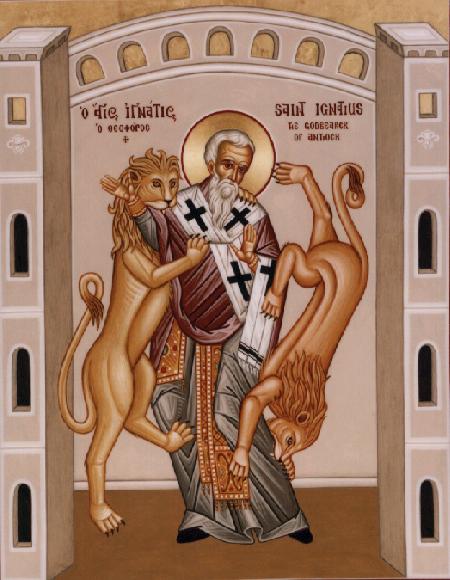
Ignatius, third Bishop of Antioch after St. Peter, on his way to martyrdom at the Flavian ampitheatre for being a Christian, wrote these pieces to ancient churches in the ancient world, c. 110 A.D.:

"[The Eucharist is] the medicine of immortality, and the sovereign remedy by which we escape death and live in Jesus Christ for evermore." (Id.)

"There is no pleasure for me in any meats that perish, or in the delights of this life; I am fain for the bread of God, even the flesh of Jesus Christ, who is the seed of David; and for my drink I crave that Blood of His which is love imperishable." (Id.)

"Make certain, therefore, that you all observe one common Eucharist; for there is but one Body of our Lord Jesus Christ, and but one cup of union with His Blood, and one single altar of sacrifice." (Id.)

"The sole Eucharist you should consider valid is one that is celebrated by the bishop himself, or by some person authorized by him." (Id.)

Saint Ignatius was sacrificed to the lions as Christ sacrificed Himself for us; that is, willing to go to death for love of others. It is no exaggeration that the Eucharist and Sacrifice that Ignatius, as Bishop, prayed so many times, is what preserved him in his martyrdom. It is through the blood of Christ, that we are Redeemed, and it is the blood of Saints such as Ignatius, shed for his fellow Christians and through love of Christ, that the seeds of Faith were planted.

Tuesday, January 15, 2008

TRUE WISDOM


Saint Alphonsus de Liguori, Doctor of the Church: "Let us be persuaded that the truly wise are they who know how to acquire the divine grace, and the kingdom of heaven; and let us incessantly implore the Lord to give us the science of the saints, which he gives to all who ask it from him. Oh! What a precious science to know how to love God, and to save our souls! This science consists in knowing how to walk in the way of salvation, and to adopt the means of attaining eternal life. The affair of salvation is of all affairs the most necessary. If we know all things, and know not how to save our souls, our knowledge will be unprofitable to us, and we shall be forever miserable: but on the other hand, though we should be ignorant of all things, we shall be happy for eternity, If we know how to love God. “Blessed is the man,” says St. Augustine, “ who knows Thee though he be ignorant of other things.” One day, Brother Giles said to St. Bonaventure: Happy you, Father Bonaventure, who are so learned. I am a poor, ignorant man, who knows nothing. You can become more holy than I can. “Listen,” replied the saint.; ‘If an ignorant old woman loves God more than I do, she shall be more holy than I am.” On hearing this, Brother Giles began to exclaim: O poor old woman! Poor old woman! Listen, listen: if you love God, you can become more holy than Father Bonaventure.
“The unlearned rise up,” says St. Augustine: “and bear away the kingdom of heaven.” How many rude and illiterate Christians, who, though unable to read, know how to love God and are saved! And how many of the learned of this world are damned! But the former, not the latter, are truly wise. Oh! How truly wise were St. Paschal, St. Felix the Capuchin, St. John of God, though unacquainted with human sciences! Oh! How truly wise were so many holy men, who, abandoning the world, shut themselves up in the cloister, or spent their lives in the desert! How truly wise were St. Benedict, St. Francis of Assisi and St. Louis of Toulouse, who renounced the throne! Oh! How truly wise were so many martyrs, so many tender virgins, who refused the hand of princes, and suffered death for the sake of Jesus Christ! That true wisdom consists in despising the goods of this life, and in securing a happy eternity, even worldlings know and believe: hence of persons who give themselves to God, they say; Happy they, who are truly wise, and save their souls! In fine, they who renounce the goods of the world go give themselves to God, are said to be undeceived. What then would we call those who abandon God for worldly goods? We should call them deluded men.
Brother, to what class do you wish to belong? In order to make a good choice, St. Chrysostom tells you to visit the sepulchers of the dead. The grave is the school in which we may learn the science of the saints. “Tell me,” says St. Chrysostom, “are you able there to discover who has been a prince, a noble, or a man of learning? For my part,” adds the saint, “I see nothing but rottenness worms and bones. All is but a dream, a shadow.” Everything in this world will soon have an end and will vanish like a dream or a shadow. But, dearly beloved Christians, if you wish to be truly wise, it is not enough to know your end, it is necessary to adopt the means of attaining it. All would wish to be saved and to be saints; but because they do not employ the means, they never acquire sanctity, and are lost. It is necessary to fly from the occasions of sin, to frequent the sacraments, to practice mental prayer, and above all, to impress on the heart the following maxims of the Gospel: ‘What doth it profit a man if he gain the whole world?’ ‘He that loveth his life shall lose it’ That is, we must even forfeit our life in order to save the soul. ‘If any man will come after me, let him deny himself.’ To follow Jesus Christ it is necessary to refuse to self-love the pleasures, which it seeks. ‘Life is His good will.’ Our salvation consists in doing the will of God. These and other similar maxims should be deeply impressed on the soul."

Tuesday, November 6, 2007

Summorum Pontificum, Athanasius and SSPX

As the world knows our Pope “liberated” the Tradition Latin Mass, or Vetus Ordo (VO: old order) mass in July. This is a significant event for the Church; possibly the most significant event since Pope Paul VI ordered the creation of the Novus Ordo (NO: new order) mass on the heels of the Second Vatican Council. The NO mass was created in a liturgical think-tank in the span of a few years, was spearheaded by Archbishop Bugnini, who some accused of being a Mason, and was promulgated in 1970.

Conspiracy theories (or, maybe not) aside, the NO mass was a radical break from nearly 2,000 years of Catholic tradition. The VO mass is an organically developed liturgy from the time of the Apostles, and has highly developed forms and linguistically beautiful prayers to show its development through the centuries; the NO mass was a novelty created by a man known to hate, or at least disregard, tradition, and has since been the catalyst for novelties which would have horrified most Catholics prior to Vatican II (and still horrify many after).

Now comes word that the Vatican may lift the “excommunications” vs. the Bishops of the Society of Saint Pius X (SSPX). Most canon lawyers and major thinkers in the Church do not think those excommunications are of the same degree or substance as most, since the SSPX has, in fact, not denied any dogma or doctrine of the Church. In fact, it was Archbishop Marcel Lefebvre’s intention to uphold the tradition, dogmas and doctrines of the Church which led him to consecrate the four Bishops, now “excommunicated” (because they were done without papal mandate). Many believe the “excommunications” are void (or voidable), null, or otherwise invalid considering the extreme emergency the Church has been going through since Vatican II. That is a point I don’t intend to discuss here, but for a general outline of the very real emergency in the Church, a good book is “The Great Facade” by Thomas E. Woods Jr. (now a mainstream writer) and Christopher Ferrera (a lawyer by trade), both of whom are faithful to Pope Benedict XVI. Written some years ago, this book outlines the extreme, universal abuses going on in the Church, the world over, and the causes thereof. In fact, this book is a treatise that, indeed, our Church is in one of the greatest crisis in Her 2,000 year history (a crisis almost imperceptible in these modernistic times, since the modernist, by definition, thinks everything is peachy keen in the world).

Which leads me to the two booklets I would like to briefly discuss: “The Eternal Sacrifice” and “Saint Athanasius; Defender of the Faith,” both by the eminent liturgist and historian, Michael Davies (Requiescat in pace), who hailed from the United Kingdom.

It’s useful to know that Pope Benedict XVI, as Cardinal Ratzinger, had great respect for Michael Davies, and spoke of losing a good son of the Church at his death; the Pope and Davies were known before Davies’ death to be on very friendly terms.

I’m not going to belabor that point, except to say it is quite percipient as to the current Pope’s mind on these things.

In his preface to “Saint Athanasius,” Davies directly implies that his reason for writing this book was to compare the situation of St. Athanasius (who was excommunicated by a Pope) with that of Lefebvre: “‘What happened over 1600 years ago is repeating itself today, but with two or three differences: Alexandria is today the whole Universal Church the stability of which is being shaken, and what was undertaken at that time by means of physical force and cruelty is now being transferred to a different level. Exile is replaced by banishment into the silence of being ignored, killing by assassination of character.’…The most evident parallel elicited in the book is that between the role played by St. Athanasius in the fourth century and that of Archbishop Marcel Lefebvre in the decades following the Second Vatican Council. It must be made clear that at no time did the Archbishop ever compare himself to St. Athanasius….” “Saint Athanasius” (Foreword, 21 March 1994, 1995, Angelus Press, citation omitted.) Indeed, St. Athanasius was banished multiple times, excommunicated by two councils (and the excommunication was ratified by Pope Liberius), and he is now one of the greatest Saints of the Church. Of that time, Athanasius writes, “The whole world groaned and was amazed to find itself Arain [the heretical belief that the Son is not co-eternal with the Father.]” Id. pg. 30. St. Athanasius wrote, “Our churches are taken from us and given to the Arians; they have our places, but with have the faith. They cannot rob us of that.” Id. pg. 20.

Obviously the differences between the modernist of today and the Arian of the fourth century are different in form. But in inherent content, the comparisons are similar: In the fourth century almost every believer in the Christian world believed in a heresy because of Arianism. Today, almost the entire Christian world believes in the heresy of all heresies: modernism: The relativistic notion that all truths [sic] lead to, or are co-equal with, the one Truth. It is syncretism and relativism wrapped all into one. And it is the direct result of Vatican II (or the Spirit thereof) and it manifests itself in joint-prayer services, Assisi I and II, and in most (or all?) of the dioceses throughout the world, which welcome, hold-hands with, and otherwise placate other faith traditions as co-equal with Catholicism; whereas in the past, through charity, we respected other faiths, and other people, but, ultimately prayed for them, and asked them in to the Catholic Faith, which is the only, sure, way to heaven. Christ is the only door to heaven (adherents in other faiths may be saved, St. Thomas Aquinas tells us, but only through the Baptism of desire, which is, arguably, a near impossibility in this day and age, where nearly everyone has heard of and knows of Christ, and few take advantage of the Sacraments, which were instituted by Christ for a reason, and not in a vacuum.)

The second book is “The Eternal Sacrifice,” which I would like to add as a contrast to the de facto heresy which exists throughout the world in denying the transubstantiation of the Eucharist: The Truth that Christ—God—is truly present in every particle of the Eucharist. It would take a thousand pages herein to outline all of the abuses to the Eucharist since Vatican II; suffice it to say, that since VII the Eucharist is passed-around by disinterested “Eucharistic ministers” to disinterested lay people who could care less about Christ truly present in the Eucharist. Today, only 25% of the 25% of Catholics who still go to mass believe in this central mystery of our Faith. This is significant, and is a direct result of the reforms during and after VII which watered-down our faith.

“‘When Christ on the Cross cried out His Consummatum est, few were the men who noticed it, fewer still the men who perceived that this phrase announced a turning point for mankind, that this death opened into everlasting life gates through which, from that moment on, all the people of the earth would pass. Now, to meet the expectant longing of mankind, this great event is arrested and, through Christ’s institution [of the mass] held fast for these coming generations so that they might be conscious witnesses of that event event in the last centuries and amongst the remotest nations, and might look up to it in holy rapture.’…[t]he Catholic Church has meaning and significance only in so far as it is directed towards God. It is equally true that it has meaning and significance only in so far as it is considered as an exercise of the priesty office of Our Lord Jesus Christ. Our Lord’s priestly office on earth did not come to an end when He ascended into heaven. He perpetuates it in His Mystical Body, the Church, which, in its innermost reality, is an extension of the Incarnation throughout the nations and the centuries. Our Lord is present among us today in His Church, teaching, ruling, and sanctifying us. Priests who have received their orders in direct succession from the Apostles offer the Mass in Christ’s name and in His person, in persona Christi. Our Lord Himself is the true High Priest of every Mass, the priest at the altar acts only as His instrument. In the traditional Mass of the Roman Rite, now commonly known as the Tridentine Mass, this sublime truth is symbolized fittingly by the manner in which the priest subordinates himself to the awe inspiring holiness and majesty of the rite which he is celebrating, the rite which Father Faber described as the most beautiful thing this side of heaven.’ A prayer in the liturgy of St. John Chrysostom evokes the profound truth that: ‘It is really Thou Who dost offer and art offered, Thou Who dost receive the offering and art given back to us, Christ our God.’ The Sacrifice of the Mass is truly the Sacrifice of Calvary made present among us, a sacrifice at which we should dare to be present only in a spirit of the utmost reverence and most abject humility, conscious of our unworthiness in the presence of the all holy God. ‘Quam terribilis est haec hora!’ cries out the deacon in the Syrian liturgy. ‘How awesome is this hour!’ Awesome it is indeed when our Savior and our God is present among us as preist and victim.” (Michael Davies, The Eternal Sacrifice, Newman Press, 1987, pages.13-14, citation omitted.)

“God is our Creator, we are His creatures. Without Him we would not exist, without Him we would not have that hope of everlasting happiness in heaven which alone enable us to endure the suffering and sorrow of our exile in this valley of tears. We owe God everything, and He owes us nothing. Those who are created have a duty to love and serve their Creator…’Who is like God?’ These are the words which should be at the forefront of the mind of every Catholic. The answer, of course, is that no one is like God. He is infinite, and we are finite. Between infinite and finite there can be no comparison. We must, therefore, as the Catechism teaches us, devote our lives to knowing, loving and serving God in this world so that we can be happy with Him forever in the next. This is our duty as His creatures.
….
The Commandments of God enjoin a solemn obligation of sanctifying the Sabbath by rendering Our Heavenly Father worthy and reverent public worship. The only adequate expression of our absolute submission to almighty God is the offering of the sacrifice. ….
The essence of sacrifice lies in the offering of a victim to God on behalf of the people by their publicly appointed representative…The most significant moment of Jewish sacrifice was the pouring of the blood of the victim upon the altar. The altar of sacrifice in the Jewish Temple represented God, just as the Christian altar represents Our Lord Jesus Christ Himself. The blood of the victim was said to contain its life, and when poured upon the altar it had been returned to God in Whom that life originated.
….
The Christian religion has only one sacrifice, the sacrifice that was once offered when Our Lord Jesus Christ, acting both as priest and victim, shed His Blood for us upon the Cross. Every type and every purpose of Old Testament sacrifice was fulfilled to perfection on Calvary. Holocaust, peace offering, sin offering were all merely types, shadows, figures of that one perfect sacrifice on the first Good Friday when God the Son made Man reconciled all tings unto Himself, ‘making peace through the Blood of His Cross, both as to the things that are on earth and the things that are in heaven’ (Col. 1:20).”

Wednesday, August 8, 2007

"On the Theology of Death"

I found the essay, “On the Theology of Death” by Karl Rahner at a garage sale last weekend, where it was given to me, gratis. I couldn’t resist the title, even though Rahner—though admittedly a brilliant theologian—was a peritas at Vatican II (that confusing but valid, non-dogmatic council of policies; instead of formulating doctrine and house-cleaning, as most councils are intended to do, VII opened the Church’s windows and invited the world to dirty the house some more). Rahner is a golden-boy of the Catholic left. He was admonished by the Vatican to quit advocating for interfaith services. So, I entered this book with some trepidation, even though the title was alluring enough for me, and, as an ex-firefighter, who used to deal with death on a daily basis, I felt compelled to read it.

At the outset, before looking at this book, let’s make very plain the concept of death, since many in our culture seem to forget about its true reality. We live in a materialistic age where matter becomes more significant to the average person than the maker. We all fancy nice cars and i-phones, even while the average person in the world lives in abject poverty. Christ said, “blessed are the poor.” Last Sunday’s reading was on-point, Luke 12: 16 – 21:


The land of a certain rich man brought forth plenty of fruits. 17 And he thought within himself, saying: What shall I do, because I have no room where to bestow my fruits? 18 And he said: This will I do: I will pull down my barns, and will build greater; and into them will I gather all things that are grown to me, and my goods. 19 And I will say to my soul: Soul, thou hast much goods laid up for many years take thy rest; eat, drink, make good cheer. 20 But God said to him: Thou fool, this night do they require thy soul of thee: and whose shall those things be which thou hast provided?

If any of us love this life, we will “lose it.”

In the context of the modern world, man forgets about his final end. Let’s realign ourselves: Everyone reading this shall die. We all will end in the grave; our bodies will corrupt until they become bones or dust, until the general resurrection at the end of time, which is a dogma of our faith. Your soul will leave your body, our God will draw your soul. Your body will corrupt. Your skin will “leather”, your eyes will shrink, first into pea pods, but then they will crumble. Your hair will matte, and begin to fall out, until all falls away. Your skeleton will remain for a time longer, as it is of stronger substance, but it too will crumble and fall away. Only your soul will live on, and that is for eternity. Eternity is a long, long time. Imagine all of the particles of sand on all of the sea shores on earth, trillions of pieces of sand, to say the least, and pretend that each piece of sand equals a billion years, and pretend that you spend this amount of time in eternity. That, of course, does not equal even one day of your life in eternity; not even one second of eternity’s time, but of course God is outside of time.

I am not illustrating anything new here--even a child can understand that point—but meditating upon this is beneficial in the context of situating our souls to face eternity. Death is the beginning of our eternity either in union or separated from God.

Like I said, I approached Rahner’s essay with great caution. Although Rahner flirts with the heterodox notion that God might have saved humanity in a perfectly non-violent, unbloody, manner, he nevertheless comes to the Orthodox conclusion that Christ’s bloody Sacrifice was not only salvific, but that God could not have saved us by any other means:

“His life redeems, inasmuch as his death is axiologically present in his entire life. And in so far as any moral act of man is to be considered as a disposing over his entire person with regard to his interior destiny, and in so far as such a disposition receives its final character only in death, it is clear (on the supposition that Christ assumed the flesh of sin and death) that we cannot really say that Christ could have redeemed us through any other moral act than his death, even had God been disposed to accept some other act.” (Herder, New York, 1961, pg. 63.)

Rahner is a notoriously hard read, and you can almost see him strain to say the words, but he did: even God, according to Rahner, could not have saved us through any other means then through the death of Christ, His Son, the Second Person of the Trinity. Some Christians tend to meditate exclusively on Christ risen (even some Bishops do this). It’s much “cleaner” to think of Christ this way. It’s more happy-clappy, feel-good. They think of Christ’s earthly ministry, His miracles, and on the periphery acknowledge that Christ’s blood washes away our sins. But, strangely, they steer from the Passion Narratives in the Bible, even though this is the summit, the apex of why Christ came among us. We don’t like to think of bloody death, but Christ and the martyrs teach us otherwise. Even Rahner dedicates the last forty pages or so of his essay to the Christian martyrs, because they were the perfect embodiment of what it means to be Christian: giving up one’s life on earth in a Christ-like sacrifice:

“[A] martyr is one who freely accepting his death in faith, is killed by powers inimical to Christ, and bears a noble testimony as a ‘witness’ to faith in Jesus Christ…Martyrdom has to do with death. In order to understand martyrdom, death must be understood. And so the mystery of death enters into martyrdom, and makes martyrdom itself a mystery. One only dares approach the subject of death hesitantly. For the hidden incomprehensibility of death is also concealed from the average everyday mind, by the fact that death happens daily, and the dullard thinks that what happens every day must be understandable.” (pg. 82-83).

But the average Christian must, too, die in Christ to attain everlasting life. Every action that we make has everlasting impart:

“But the affirmation of faith concerning the definitive ending by death of the state of pilgrimage means, as well as the survival of man’s conscious personal existence, that the fundamental moral decision made by man in the mundane temporality of his bodily existence, is rendered definite and final by death. This doctrine of the faith involves taking this earthly life with radical seriousness. It is truly historical, this is, unique, unrepeatable, of inalienable and irrevocable significance.” (pt. 27.)

Rahner doesn’t shrink from the concept of original sin; what else explains the often absurd dimension of sin and suffering on earth?

“[D]eath is a visible expression of the disharmony between God and man in man’s very being which supervened at the beginning of his spiritual and moral history. Because man has lost the divine life in union with God by grace, his earthly existence also disintegrates. Man’s subjection to death is the manifestation of his disharmony with God.” (pg. 34).

“The end of man, considered only from man’s point of view, presents an inseparable and irreducible unity an ontologically dialectical opposition of elements…with no assurance that it [death] will strike him at the moment in which interiorly he has completed his life. Death is a blow of fate, a thief in the night, an emptying and reducing of man to powerlessness, in fact, the end.” (pg. 40).

“It [death] will always, therefore, include the character of a divine judgment among its notes. But it is sin that is manifested in death. The emptiness, hopelessness, the transitoriness, indeterminateness, the inextricable confusion of noblest action and most humiliating passivity, of plain meaning and ultimate ambiguity, all these characteristics of the death which we must actually die are nothing but the manifestations of sin, to which in some higher and hidden dimension these characteristics analogically belong. Because a creature belonging to God, it shrinks back, by a movement of its very essence, from this last mystery of emptiness, of finality, of nothingness, form the mystery of iniquity. Because this same creature, whether holy or sinful, is driven as long as he lives by the power of the divine life which calls him and works in him, he will always experience a mysterious horror of death, which can never be explained by himself, or from what he can observe in himself. In this horror of death, there emerges on the visible surface of human life, the horror of that death which alone is true death. If men try effectively to hide the reality of this horror from themselves by explaining it away by their manner of life, by taking refuge either in frivolity, despair or tragic heroism, then by this very act they make of it what they will not admit terrifies him in it, the beginning of eternal death. Death and man’s attitude towards it, which of course is really part of its very nature, is not abolished or extinguished by is permanently transformed only when in the light and power of Jesus Christ who died and rose again, it is seen and borne as what is can be, the darkness of that night of the Cross in which eternal life penetrated in death the very depths of the world, in order to give life to the world.” (pg. 55).

The Bible is full of passages concerning death, and the Christian’s relation to it. (Cf. Rom 1:32; 7:9-10; 6:16, 21, 23; 7:5; 8:2; James 1:15 and much of St. John, etc.) But it’s Christ’s death, and dying in Christ, which is the refuge, the final hope of the Christian:

“A Christian in the state of grace dies a different death from that of the sinner…the Council of Trent…states…that the death of the Christian in the state of grace no longer has the mark of a punishment for sin, but, like concupiscence in the justified man, has the character of a mere consequence of sin (poenalitas sed non poena)” (pg. 67).

To die in a state of grace we must frequent the Bread of Life. In John 6:54-59 Christ tells us:

Jesus said to them: Amen, amen I say unto you: Except you eat the flesh of the Son of man, and drink his blood, you shall not have life in you. 55 He that eateth my flesh, and drinketh my blood, hath everlasting life: and I will raise him up in the last day. 56 For my flesh is meat indeed: and my blood is drink indeed. 57 He that eateth my flesh, and drinketh my blood, abideth in me, and I in him. 58 As the living Father hath sent me, and I live by the Father; so he that eateth me, the same also shall live by me. 59 This is the bread that came down from heaven. Not as your fathers did eat manna, and are dead. He that eateth this bread, shall live for ever.

St. Paul writes in 1 Cor. 24-26:

24 And giving thanks, broke, and said: Take ye, and eat: this is my body, which shall be delivered for you: this do for the commemoration of me. 25 In like manner also the chalice, after he had supped, saying: This chalice is the new testament in my blood: this do ye, as often as you shall drink, for the commemoration of me.
26 For as often as you shall eat this bread, and drink the chalice, you shall shew the death of the Lord, until he come.

This is why the traditional Latin Mass is so important, and has been the source and training-ground of so many Catholic Saints. In it, we “shew the death of the Lord.”

Rahner writes:

“The second sacrament which repeatedly and visibly reveals and deepens this companionship in suffering and death with our Lord, by grace throughout the whole course of the Christian life, is the sacred mystery of the Eucharist. This is the continuously renewed celebration of the death of the Lord, making that death present here and now in our lives. In the Eucharist, according to his command, we announce his death, which is our death and our life, again and again until he comes once more and it is no longer revealed in ritual sign but in the radiance of his visibly manifested glory, that in his death our death is swallowed up by the victory of life. What is done in this mystery is the sacramental enactment of Christ’s death, and what we receive in this mystery is the grace which became ours, n his death…In this sacrifice and sacrament, not only is the mystery of the Cross brought near to us in a spatio-temporal relation, but it actually produces its effect on our own lives, drawing us into itself, subjecting us to its own unfathomable laws and communicating its strength to us. Of necessity, therefore, anyone who takes part in this mystery in divine worship, announcing in it the death of the Lord, must also announce this death in his own life, by experiencing it in himself in the reality of his life…For we must consider as the effect of this sacrament all that Scripture means by our communion in the passion and death of Christ: that we must suffer with him, in order to be glorified with him (Rom 8:17; that though participation in his passion we are conformed to his death (Phil 3:10); that he has to be glorified in our bodies in life and in death (Phil 1:20); that for Christ’s sake we are constantly delivered into the power of death (2 Cor 4:10f.); that with him who was crucified in infirmity, we also are weak (2 Cor 13:4); that it is a grace, not only to believe in Christ, but also to suffer for him (Phil 1:29; that only if we have died with him shall we live with him (2 Tim 2:11). We share his death because we daily celebrate and receive the sacrament of his death.” (Pg. 76-77)

I will end by quoting that beautiful passage in the Bible of the raising of the twelve year old daughter of Jairus Luke 8:41-55:

41 And behold there came a man whose name was Jairus, and he was a ruler of the synagogue: and he fell down at the feet of Jesus, beseeching him that he would come into his house: 42 For he had an only daughter, almost twelve years old, and she was dying. And it happened as he went, that he was thronged by the multitudes.
….
49 As he was yet speaking, there cometh one to the ruler of the synagogue, saying to him: Thy daughter is dead, trouble him not. 50 And Jesus hearing this word, answered the father of the maid: Fear not; believe only, and she shall be safe.
51 And when he was come to the house, he suffered not any man to go in with him, but Peter and James and John, and the father and mother of the maiden. 52 And all wept and mourned for her. But he said: Weep not; the maid is not dead, but sleepeth. 53 And they laughed him to scorn, knowing that she was dead. 54 But he taking her by the hand, cried out, saying: Maid, arise. 55 And her spirit returned, and she arose immediately. And he bid them give her to eat.

Sunday, July 29, 2007

"The Eucharist makes the Church"


When we look at the great Cathedrals in Europe, they were built to give glory to God. The highest expression of glorifying God is through the unbloody Sacrifice of the Mass. In a very real sense, then, the Cathedrals of Europe were built to house the Latin Mass, and Gregorian Chant. Today, they are all too often tourist attractions and living history museums, which perhaps is the only thing keeping them open, funded and maintained. Mass attendance in Europe hovers at around eight percent of the population even in such purportedly "Catholic" countries as France. Instead of maintaining tradition, and nurturing the ancient, beautiful Sacrifice of the Tridentine Mass (which itself was a mere codification of the mass dating back to the time of St. Gregory the Great), which would certainly increase mass attendance, many Bishops want to trivialize even the great Cathedrals. I was in Notre Dame Cathedral a few months ago. There was a giant projection screen over the altar, draped in such a way as to make it look like a giant sail. On it were projected words. The overall effect was one of banality, and trying to be "cool", "hip", even "avant garde." When will some Bishops get a clue? People want to be transported out of the banal, media-saturated world when they go to mass, not back into it.